
What evidence proves fault in a truck accident
Introduction to fault and responsibility in truck accidents
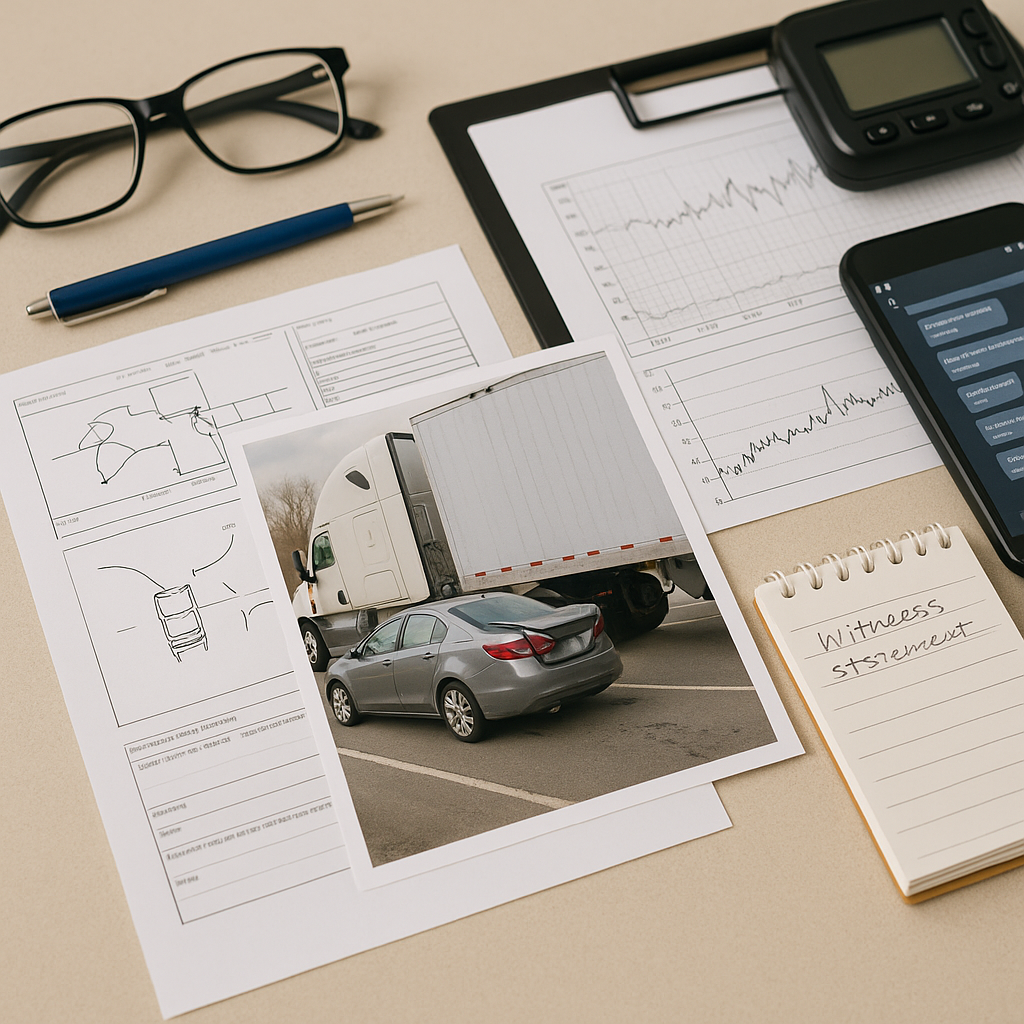
Determining fault in a truck crash often involves more than comparing two drivers’ stories. Because commercial vehicles are regulated, equipped with onboard technology, and operated within company systems, investigators typically look for objective proof that shows what happened, why it happened, and who had control over the risks. The most persuasive evidence fault truck accident investigations rely on usually falls into physical evidence, electronic data, documents, and third-party testimony.
How fault is typically evaluated in this type of situation
Fault is generally assessed by comparing each party’s actions to traffic laws, safety rules, and reasonable driving standards, then linking any violations to the crash.
Key factors that influence who may be responsible
Common factors include speed choice, following distance, lane-change behavior, right-of-way decisions, visibility, roadway conditions, vehicle condition, driver alertness, and whether cargo was safely loaded and secured.
How different parties can share or shift liability
Truck accidents may involve shared responsibility. Beyond the truck driver, a carrier (trucking company), maintenance vendor, shipper/loader, parts manufacturer, or another motorist may contribute through unsafe policies, poor repairs, improper loading, defective components, or triggering events on the road.
How evidence is used to determine fault
Investigators typically build a timeline and test it against independent data sources. Key evidence categories include:
– Police reports and citations: Officer diagrams, measured observations, and documented violations (e.g., unsafe lane change, following too closely).
– Photos and video: Damage patterns, skid marks, debris fields, and final vehicle positions; dashcams, traffic cameras, and nearby surveillance can confirm movement and signal timing.
– Witness statements: Neutral bystanders often help resolve disputed details; passenger statements can corroborate a sequence of events.
– Truck “black box” (ECM/EDR) data: Speed, braking, throttle, RPM, and pre-crash events can show whether evasive action occurred.
– Driver logs and hours-of-service (ELD) records: Driving time and rest breaks may indicate fatigue risk, violations, or inconsistent logging.
– Cell phone and dispatch records: Call/text timestamps, app activity, and dispatch messages may help evaluate distraction or scheduling pressure.
– Maintenance/inspection records: Brake, tire, lighting, and steering history may reveal neglected repairs or missed inspections.
– Cargo documentation: Bills of lading, weight tickets, and securement records can point to overweight or shifting loads.
– Toxicology/impairment evidence: Test results and officer observations may confirm or rule out impairment.
– Expert reconstruction: Specialists interpret physical and digital evidence to model speeds, timing, and impact dynamics.
– Company policies and safety history: Training, audits, and prior violations may contextualize supervision and compliance.
– Medical records: Injury patterns and timelines can support consistency with the claimed crash mechanics.
Common complications in determining liability
Liability can be complicated by conflicting accounts, incomplete video, weather effects, multiple impacts, or missing/overwritten electronic data. Questions may also arise about whether a driver acted reasonably in an emergency created by another party.
General awareness of how fault can impact outcomes and next steps
Fault findings may affect insurance decisions, potential claims, and whether responsibility is apportioned among multiple parties. The credibility and preservation of records often shapes how clearly fault can be evaluated.
Closing informational summary (neutral and balanced)
In truck crashes, the clearest fault determinations usually come from evidence that independently confirms speed, braking, lane position, driver condition, vehicle condition, and cargo control. Because responsibility can extend beyond the driver, a thorough review typically considers both on-road behavior and behind-the-scenes records that influenced safety.