
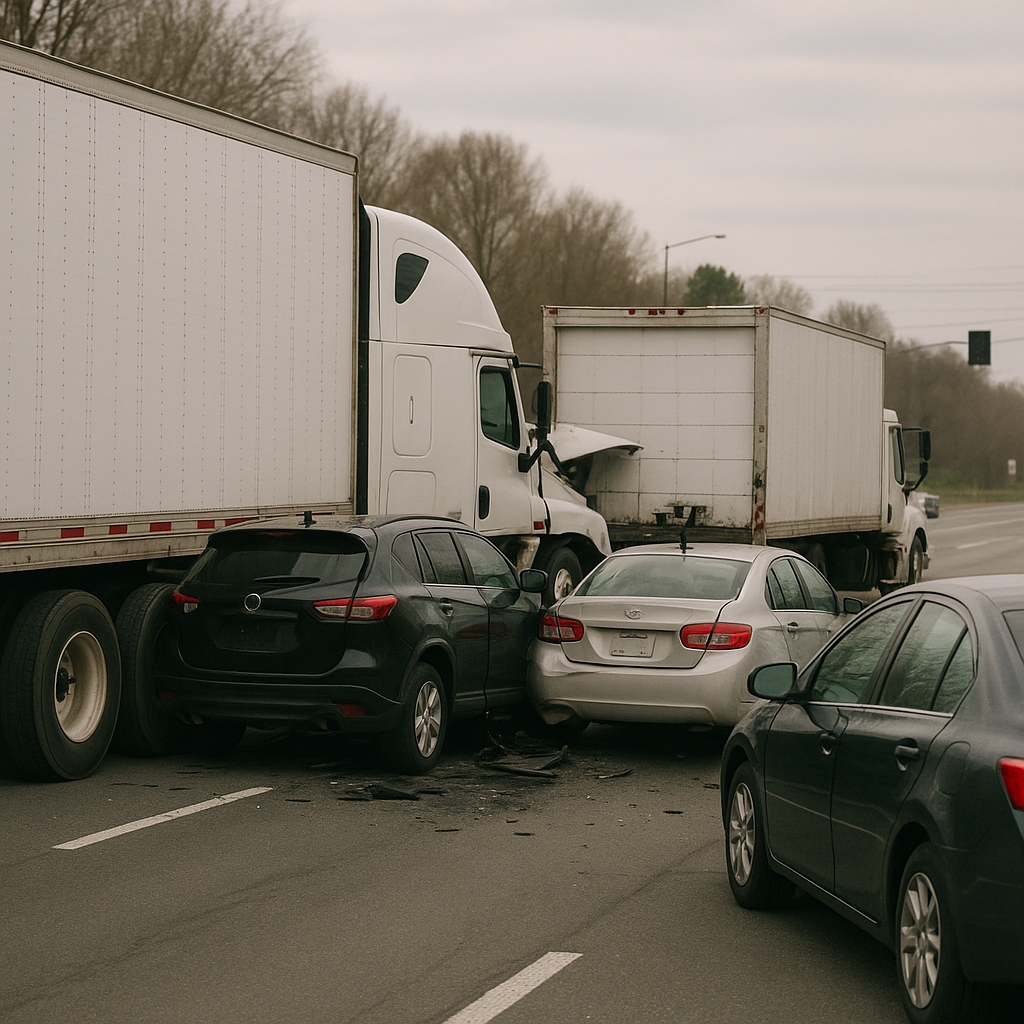
What happens in multi vehicle truck accident liability cases
Introduction to fault and responsibility in truck accidents
A multi vehicle liability truck accident can involve several moving parts at once: multiple drivers, a commercial truck, and overlapping insurance coverage. Because chain-reaction crashes can unfold in seconds, responsibility is rarely obvious from vehicle damage alone. Liability is typically determined by reconstructing what happened and assessing how each person or company’s actions contributed to the overall crash and resulting damages.
How fault is typically evaluated in this type of situation
Fault analysis often starts with the timeline of the collision and the driving decisions made just before impact. Investigators and insurers commonly examine the sequence of events to determine whether one initial error triggered a “domino effect,” or whether several independent actions combined to create the crash.
Key factors that influence who may be responsible
Common factors include:
– Sequence of impacts: who hit whom first, and whether later impacts were avoidable
– Traffic law compliance: speed, following distance, lane changes, signaling, right-of-way, and stopping behavior
– Road and visibility conditions: congestion, work zones, weather, and sightlines
– Driver condition and conduct: fatigue, distraction, impairment, and reaction time
How different parties can share or shift liability
Multi-vehicle truck cases may involve more than just the truck driver. Depending on the facts, potential responsible parties can include the trucking company, maintenance providers, cargo loaders/shippers, parts manufacturers, and other passenger vehicle drivers. Many jurisdictions apply comparative or contributory fault rules, meaning liability (and payment responsibility) may be divided by percentage. In practical terms, a person’s financial recovery may be reduced if they are found partially at fault, and some systems limit recovery if fault exceeds a defined threshold.
How evidence is used to determine fault
Evidence often drives the outcome in a multi vehicle liability truck accident claim. Common sources include police reports, witness statements, photographs, skid marks, debris fields, and vehicle resting positions. Truck-specific data can also be important, such as electronic logging devices (ELDs), dispatch instructions, maintenance and inspection records, GPS history, phone records, and event data recorder/ECM information. Accident reconstruction experts may use these inputs to model timing, speeds, and impact angles.
Common complications in determining liability
Trucking collisions can be more complex than typical pileups due to federal and state regulations, company-controlled records, and layered commercial insurance (primary and excess policies, multiple carriers). Disputes may arise over data interpretation, preservation of records, or whether a later driver had a reasonable opportunity to avoid the collision.
General awareness of how fault can impact outcomes and next steps
These cases often proceed through investigation, fault allocation, insurance negotiations, and—when disagreements persist—litigation. Outcomes can involve multiple settlements, contested percentages of fault, and longer timelines than two-vehicle crashes, especially when injuries or damages are significant.
Closing informational summary (neutral and balanced)
In multi-vehicle truck crashes, liability is usually determined through detailed reconstruction, careful evidence review, and application of fault-allocation rules. Because multiple parties may contribute to a chain reaction, responsibility can be shared across drivers, companies, and other entities, with compensation shaped by each party’s percentage of fault.